Geological hazard assessment simulation
The rock mass structure is extremely complex. As a result, current technology can only achieve qualitative evaluation of geological hazards related to rock masses, and it is difficult to achieve breakthroughs in prediction and quantification considering complex structures. Therefore, the research team features rock mass structure and focuses on the three major chronic diseases of geological disasters, namely collapse, landslide and debris flow, and extends the static evaluation of rock mass structure to the dynamic quantification of disasters, in order to deepen the understanding of the geological disaster chain mechanism and promote engineering practice. Increase the pertinence and foresight of geological disaster prevention, as detailed below.
① Intelligent search, identification and evaluation of large-scale global dangerous rock masses
For complex slope structural surfaces (Fig. 1a), by introducing geometric topology and ridge vector analysis method, an intelligent search algorithm for global dangerous blocks on slopes was developed. Based on the high-precision structural surface data set, geometric analysis methods and depth-first algorithm search are used to achieve precise positioning and geometric characterization of in-situ dangerous rock mass (Figure 1b); and comprehensive consideration of its physical characteristics and macro boundary conditions, combined with Mechanical analysis and key block theory realize the risk assessment of dangerous rock masses. This algorithm realizes the automatic identification and three-dimensional positioning of dangerous blocks with complex shapes in large-scale areas, identifies the spatial distribution rules of dangerous rock masses with fissures on ultra-high steep slopes, and achieves the stability of corresponding dangerous rock masses under different structural plane combination modes. analyze.
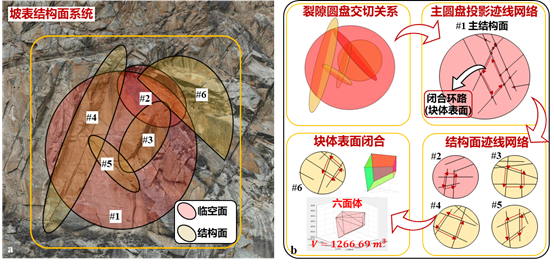
Figure 1 (a) Slope surface structural surface system and in-situ dangerous rock mass (b) Flow chart of intelligent search algorithm for dangerous rock mass
② Refined block modeling significantly improves the accuracy of rockfall hazard analysis
For the first time, the cracking effect of the block was included in the rockfall analysis. Taking the internal structural plane of the block as the core control factor, and with the help of the discrete element method, the dynamic process of the collapse rockfall under the action of the cracking effect was deeply analyzed (Figure 2). This method significantly makes up for the limitations of traditional rockfall dynamics analysis. By incorporating the complex changes in the internal structure of moving rolling stones into the analysis framework, it realizes the transformation of rockfall analysis from rigid body dynamics to discrete medium dynamics. Through this method, we can reflect the interaction between the block crushing effect and the block dynamic parameters, thereby obtaining numerical simulation results that are closer to the actual site, providing important theoretical support for rockfall risk assessment and protection.
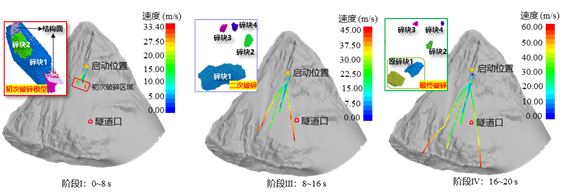
Figure 2 Dynamic analysis considering block crushing effect
③ Graph theory algorithms help break through the dimensional limitations of delineating critical sliding surfaces
For the first time, a geometric search scheme for the three-dimensional critical sliding surface of rock slopes based on graph theory is proposed. Taking the failure mode of rock slopes as the entry point, the shortest path is cleverly used to solve the three-dimensional failure surface search problem, that is, the main sliding surface and the three-dimensional critical sliding surface are searched separately. The failure (shortest) path of the lateral separation surface, the entire critical sliding surface can be obtained by combining all failure paths (Figure 3). This technology fully considers a large number of structural plane systems with complex characteristics, and breaks through the delineation of complex structural rock slope landslides from "two-dimensional" to "three-dimensional", making it possible to calculate the three-dimensional stability and dynamic analysis of complex structural rock masses.
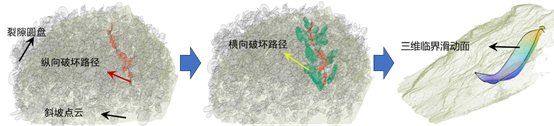
Figure 3 Three-dimensional critical sliding surface geometry search scheme
④ Multi-scale structural plane consideration promotes the dual improvement of accuracy and efficiency of overall slope stability analysis
In view of the large and complex structural surface system of high and steep slopes, an overall stability analysis method of the slope that can truly reflect the influence of structural surfaces of different scales is proposed. This method comprehensively considers the information of multiple scale structural planes, and “explicitly” considers the geometric and mechanical parameters of large-scale and mesoscale structural planes, while “implicitly” considering the degradation effect of equivalent small-scale structural planes on rock mass strength (Fig. 4 ). While reflecting the complex structure of high and steep slopes, it also greatly improves the efficiency of slope stability analysis. The slope deformation and failure results show that structural surfaces of all scales have a certain impact on stability. Therefore, consideration of multi-scale structural surfaces is an effective way to reasonably and accurately evaluate the stability of high and steep slopes.
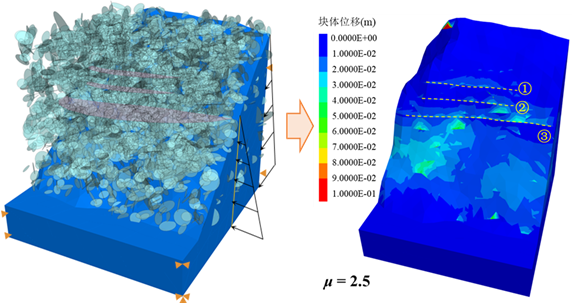
Figure 4 Slope stability analysis based on multi-scale structural geological model